


It's been great getting so many interesting comments on the Jock Wallace and Enzo Maresca threads, and while Leicester v West Brom is still topical I'd like to post something else here. I write about football history generally, not just the foxes, and here I'd like to give an outsider's view on a few stand-out moments in Albion's history. You might think the choices a little bizarre, or too biased towards the dim and distant past, but please comment and tell me what you think. I'll present it as a Top Ten, in reverse order.
10) Bobby Moore's Golden Run Comes To An End
He'd done it 1964, leadng West Ham to victory in the Cup Final at Wembley.
He'd done it the following year as the Hammers lifted the European Cup Winners Cup - at Wembley.
And of course in 1966 he'd climbed the same 39 steps to lift the Jules Rimet Trophy.
Now, a year on, he had a chance to stretch that incredible run to four. West Ham were in the semi-finals of the League Cup, and this season, for the first time, the final would be at Wembley. Their opponents in the last four were West Brom.
Bobby's dream was shattered inside 45 minutes at The Hawthorns as Albion raced into a four goal lead, Jeff Astle wth a hat-trick. That was the final score and the second leg was a low-key 2-2 draw. Albion were back at Wembley after 14 years, but they'd have to wait until they went back the following season - in the FA Cup - before they could celebrate.
9) Wembley? Again?
It's a bit boring now, isn't it? The semi-finals of the FA Cup are at the same venue as the final. I'm not sure I can even be bothered to watch this weekend. But it must have been great fun being an Albion fan way back when, before Wembley was even at the planning stage, when the club's exploits in the FA Cup took them on a grand tour of the great venues of the era.
The first 50 years of the FA Cup Final can be split broadly into two periods - The Oval era and the Crystal Palace era. Albion played in the last final at The Oval, and the first one at the Palace. They were both agaisnt Aston Villa - one won and one lost.
Albion had already played three finals at The Oval in the 1880s, and one of those went to a replay at The Racecourse Ground in Derby, the first ever Cup Final north of London. That was a 2-0 defeat to Blackburn Rovers.
Semi-Finals provided even more variety, and two in particular stand out, both in the same city.
In 1889, Albion lost to Preston North End in the first ever semi-final at Bramall Lane. Charles Clegg, a legend in Sheffield football, was so impressed by the size of the crowd that he decided to establish a new club and base them at Bramall Lane. They were called Sheffield United.
The Wednesday had previously played games at that venue, but had recently moved across the city to Owlerton. The first semi-final staged at that ground was in 1912 - and Albion were back in town, beating Blackburn Rovers before losing in a final replay - at Bramall Lane.
The Owlerton Stadium would soon be renamed Hillsborough, and it was the tragedy there that was the trigger for the FA switching all semi-finals to Wembley. Though whether the main concern was for safety rather than finance is still open to dispute.
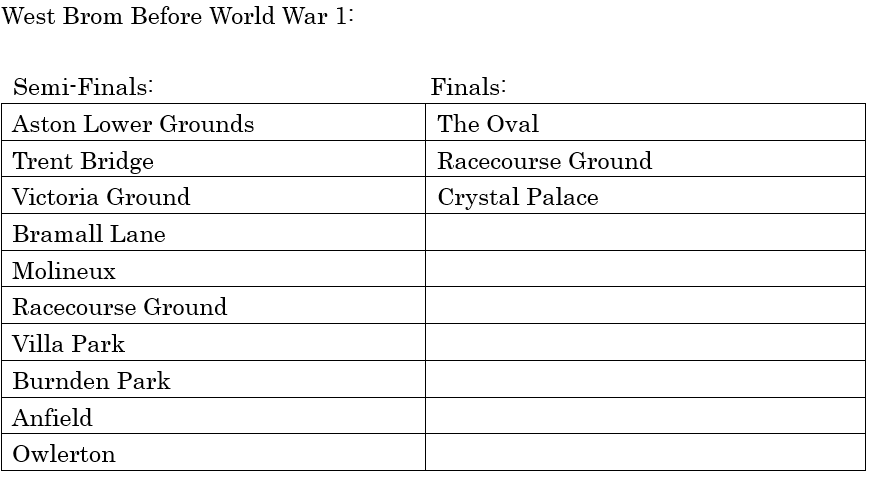
Here's the full list of neutral venues Albion played at before World War One:
I'm sure there must have been a few fans who went to every one of those game between 1886 and 1912. What a shame no-one ever thought of writing down their adventures in a diary back then. It would make an incredible read.
8) I love Salomon Rondon.
This is an unashamedly Leicester-linked entry. One of the turning points in the 2016 title race was Albion's visit to White Hart Lane on April 25th. Late in the game, Spurs were strolling to a 1-0 victory, Albion having barely mustered an attempt at goal. Then Salomon Rondon got free on the right and let go a blistering shot that Hugo Lloris just managed to get a hand to. A few moments later, Craig Dawson nodded in Craig Gardner's corner. Spurs dropped two points, and suddenly Leicester could clinch the title if they won at Old Trafford the following Saturday.
That Rondon shot is impossible to find online (unless you know better), but it's forever imprinted on my mind. Its power seemed somehow to shake Spurs, and signal that something momentous was about to happen. And I could forgive Rondon now for the goal at the King Power a month earlier in the only game that season I got back to the UK to see live.
7) Let's Take It Out On Jimmy Bloomfield
Straight on with another Leicester connection, but this time it's Albion who are the main players.
In 1977, the National Front put a huge amount of resources into the local elections in Leicester. Buoyed by a 16% share of the vote a year earlier, they thought they could go even higher, and establish a real presence on the local council in a city with a large ethnic minority population. Their policy of forced repatriation for people whose skin was a different colour to their own seemed to be striking a chord.
With election day approaching, a full pade advert appeared in the Leicester Mercury under the banner of 'Unity Against Racialism', calling for people to steer clear of the Front at the ballot box. It was signed by a huge range of local organisations and prominent individuals. One of them was Jimmy Bloomfield, manager of Leicester City.
Now at that time, there was a fairly visible NF presence at Filbert Street, and Bloomfield's stance got a few backs up.
The importance of that advert is impossible to judge, but in the elections, the NF vote collapsed, and they were never a serious force in the city again.
Two days after the count, West Bromwich Albion turned up at Filbert Street for what seemed to be a meaningless end of season game. It didn't turn out lke that.
In the Albion side was 21 year old Laurie Cunningham, and his every touch was greeted with monkey noises. Laurie responded in the way he would so often over the next two seasons - by displaying the full ranage of his skills.
The home fans were already restless after two early Albion goals, and then Laurie struck. As the Mercury reported, 'the goal of the game came when Cunningham rounded off a fine run with a curling shot beyond Wallington'.
For many of those fans making monkey noises, this would have been the first time they'd ever seen a black player score at Filbert Street (Clyde Best had done it for West Ham in 1972). And now they were silenced. Or at least you might have thought so.
In the second half, Albion added two further goals and Leicester had lost 5-0. The crowd's reaction was extraordinary. Perhaps the most volatile outpouring of hostility toward a Leicester manager the ground had ever witnessed.
Of course, many fans were simply reacting to the state of affairs on the pitch. Fans have every right to make their voices heard, especially after a performance as shabby as that one. But the cries of 'Bloomfield Out!' were given extra venom by a section of the crowd who'd suffered a triple humiliation in recent days - their manager coming out boldly as an anti-racist; their political tribe being trounced at the ballot box, and then to really rub it in, a black player stuffing their monkey noises back down their throats.
Bloomfield resigned shortly afterwards, a sad end for the man who just a couple of years earlier was lauded as a genius for building the most enteratining side that Leicester had ever seen.
We'll come back to Laurie Cunningham later.
6) The Record Breakers
No team in the First Division had ever scored as many as 90 goals in a seson before. Then in the first season after World War One, Albion went goal crazy. They scored 104 and stormed to the title. OK, there were now two more teams in Division One, but this was a rate of scoring previously unseen. The next highest total that season was 75. Fred Morris got 37 himself, and I'd love to read his book 'My Season of Plunder' - except there is no such book. Just like the fans, footballers just didn't think anyone would be interested in reading their story, and so he never wrote it down.
5) The Big Five
That League Cup Final defeat to QPR in 1967 was Albion's first ever defeat in the competition. They had won it the pevious season, beating West Ham in the last two-legged final. Before that they had considered it beneath them. Back in 1960 when the League Cup got off the ground, none of the 'Big Five', as they were then called, entered the competition. Those five were Arsenal, Tottenham, Sheffield Wednesday, Wolves - and West Brom.
There was a lot of talk of a breakaway League at the time, and Albion were taking steps to cement their place in that elite. This was secretary Alan Everiss in January 1962, talking about a new car park at The Hawthorns with space for 700 cars:
We realise that the days of a Super League and European League will come, and we mean to be part of it. It is proposed to have motorways from London, Bristol and Preston linking up on part of Sandwell golf course, which will mean Albion is one of the easiest grounds in the country to reach.
4) 15,000 couldn't get in.
Back to Filbert Street for more Albion glory.
Five days after the 1931 FA Cup Final, in which Albion famously beat Birmingham City 2-1, came a vital Divison Two game. Albion needed to win at Stoke to move into a promotion position, and everyone wanted to be there. Reports speak of 'an amazing procession of vehicles crowding the road from Birmingham to Stoke'. Two crucial points from a 1-0 win took Albion into second place, and two days later came a 3-2 home win over Charlton to seal the return to the top flight.
18 years after that came another 'amazing procession', this too five days after the Cup Final. Albion needed to win at Filbert Street on May 5th 1949 to clinch promotion, and Leicester were desperate for the points to avoid suffering a truly unique double blow - losing at Wembley followed by relegation to Division Three.
Leicester had lost the Final 3-1 to Wolves, but as plucky underdogs had become the nation's favourite team. Albion's visit was the first chance for fans to welcome them back to Filbert Street.
It was a perfect storm, right at the time football attendances were reaching an all time high. By mid-afternoon, the city of Leicester was gridlocked. 'Besides the huge contingent of vehicles from Birmingham, there were buses and cars from every corner of Leicestershire'.
That evening, there were more people crowded around those narrow terraced streets than at any time in history. Conservative estimates put the number locked out at 15,000. The crush round the ground was becioming dangerous, and 2,000 got in when a gate was forced open, before 'a police car was driven across the forced entrance to block the flow'. Those who made it inside for free found that they couldn't see over the heads of those in front. There was simply no more room on the terraces.
When the game began, Albion quicly took the lead, a goal from Davy Walsh 'coinciding with a brilliantly-hued rainbow over the Filbert Street end'. Two more goals followed, and Albion could celebrate, as 'hundreds of West Bromwich supporters, ignoring the police, raced on to the field to mob their idols'
Leicester had to wait two more days before getting the point at Cardiff that kept them in Division Two.
3) 30,000 Baggies Historians
As the 1953/54 season neared its climax, with Albion closing in on the first double of the 20th century, the Sports Argus began a series called 'Amazing Albion'. In week one, Charles Harrold wrote:
If there is one topic that can be guaranteed to keep a group of Black Country football fans talking hard from opening time to closing time these days, it is trying to sort out a definite point along the years that can be agreed upon as the beginning of West Bromwich Albion's climb to the heights.
Such a great image.
Harrold wrote that a leading candidate for that key moment was two years earlier, when Joe Kennedy was switched from right half to centre half.
2) How Flair Can Be Punished
In Kicker Conspiracy, the track that is undoubtedly the greatest football song ever recorded (a view I believe Frank Skinner shares), The Fall's Mark E Smith introduces us to the character 'Marble Millichip', who broods on 'how flair can be punished'. Bert Millichip, of course, was West Brom chairman and a key figure on the FA international selection committee in the late 70s and early 80s.
Laurie Cunningham broke into the England Under-21 side around the time he was scoring that spectacular goal at Filbert Street, and on September 6th 1977, he was the star as they beat Norway 6-0 at Brighton.
The following night, the senior side played out a dull goalless draw against Switzerland in a friendly at Wembley.
England's next game was in Luxembourg, a qualifier for the 1978 World Cup in Argentina. We knew that goal difference was likely to play a key role, as we looked like finishing level on points with Italy. We needed a hatful in Luxembourg to have a chance. Would Ron Greenwood, appointed temporary England manager weeks earlier, move some of those exciting youngsters up from the under-21s? There were calls in the press for Cunningham to be given his full debut as soon as possible.
But when the next squad was announced, he was not in it. He was in the Under-21 side again - starring once more in an 8-1 victory over Finland at Hull. The same night, the seniors managed a miserable two goals against Luxembourg.
In his column in the Sandwell Evening Mail, Cunningham said, 'The full side's failure is down to a lack of imagination among the strikers. It's all so different in the under-21s, where adventure and attack are the key notes'.
Three days later, Italy showed how it's done, hammering Finland 6-1. Our hopes of qualification had gone.
Two months later, Millichip and the rest of the FA committee had to choose the next full time England boss. Brian Clough was one of those interviewed, but he didn't get the job. Greenwood was made permanent boss.
1) I said you might find some of these choices bizarre, but really, the top selection could only be this. I know you've all watched this dozens of times. So have I, and so, no doubt, have all football lovers.
Take it away, Gerald Sinstadt:
https://www.youtube.com/watch?v=XTAMsgAdsII
10) Bobby Moore's Golden Run Comes To An End
He'd done it 1964, leadng West Ham to victory in the Cup Final at Wembley.
He'd done it the following year as the Hammers lifted the European Cup Winners Cup - at Wembley.
And of course in 1966 he'd climbed the same 39 steps to lift the Jules Rimet Trophy.
Now, a year on, he had a chance to stretch that incredible run to four. West Ham were in the semi-finals of the League Cup, and this season, for the first time, the final would be at Wembley. Their opponents in the last four were West Brom.
Bobby's dream was shattered inside 45 minutes at The Hawthorns as Albion raced into a four goal lead, Jeff Astle wth a hat-trick. That was the final score and the second leg was a low-key 2-2 draw. Albion were back at Wembley after 14 years, but they'd have to wait until they went back the following season - in the FA Cup - before they could celebrate.
9) Wembley? Again?
It's a bit boring now, isn't it? The semi-finals of the FA Cup are at the same venue as the final. I'm not sure I can even be bothered to watch this weekend. But it must have been great fun being an Albion fan way back when, before Wembley was even at the planning stage, when the club's exploits in the FA Cup took them on a grand tour of the great venues of the era.
The first 50 years of the FA Cup Final can be split broadly into two periods - The Oval era and the Crystal Palace era. Albion played in the last final at The Oval, and the first one at the Palace. They were both agaisnt Aston Villa - one won and one lost.
Albion had already played three finals at The Oval in the 1880s, and one of those went to a replay at The Racecourse Ground in Derby, the first ever Cup Final north of London. That was a 2-0 defeat to Blackburn Rovers.
Semi-Finals provided even more variety, and two in particular stand out, both in the same city.
In 1889, Albion lost to Preston North End in the first ever semi-final at Bramall Lane. Charles Clegg, a legend in Sheffield football, was so impressed by the size of the crowd that he decided to establish a new club and base them at Bramall Lane. They were called Sheffield United.
The Wednesday had previously played games at that venue, but had recently moved across the city to Owlerton. The first semi-final staged at that ground was in 1912 - and Albion were back in town, beating Blackburn Rovers before losing in a final replay - at Bramall Lane.
The Owlerton Stadium would soon be renamed Hillsborough, and it was the tragedy there that was the trigger for the FA switching all semi-finals to Wembley. Though whether the main concern was for safety rather than finance is still open to dispute.
Here's the full list of neutral venues Albion played at before World War One:
I'm sure there must have been a few fans who went to every one of those game between 1886 and 1912. What a shame no-one ever thought of writing down their adventures in a diary back then. It would make an incredible read.
8) I love Salomon Rondon.
This is an unashamedly Leicester-linked entry. One of the turning points in the 2016 title race was Albion's visit to White Hart Lane on April 25th. Late in the game, Spurs were strolling to a 1-0 victory, Albion having barely mustered an attempt at goal. Then Salomon Rondon got free on the right and let go a blistering shot that Hugo Lloris just managed to get a hand to. A few moments later, Craig Dawson nodded in Craig Gardner's corner. Spurs dropped two points, and suddenly Leicester could clinch the title if they won at Old Trafford the following Saturday.
That Rondon shot is impossible to find online (unless you know better), but it's forever imprinted on my mind. Its power seemed somehow to shake Spurs, and signal that something momentous was about to happen. And I could forgive Rondon now for the goal at the King Power a month earlier in the only game that season I got back to the UK to see live.
7) Let's Take It Out On Jimmy Bloomfield
Straight on with another Leicester connection, but this time it's Albion who are the main players.
In 1977, the National Front put a huge amount of resources into the local elections in Leicester. Buoyed by a 16% share of the vote a year earlier, they thought they could go even higher, and establish a real presence on the local council in a city with a large ethnic minority population. Their policy of forced repatriation for people whose skin was a different colour to their own seemed to be striking a chord.
With election day approaching, a full pade advert appeared in the Leicester Mercury under the banner of 'Unity Against Racialism', calling for people to steer clear of the Front at the ballot box. It was signed by a huge range of local organisations and prominent individuals. One of them was Jimmy Bloomfield, manager of Leicester City.
Now at that time, there was a fairly visible NF presence at Filbert Street, and Bloomfield's stance got a few backs up.
The importance of that advert is impossible to judge, but in the elections, the NF vote collapsed, and they were never a serious force in the city again.
Two days after the count, West Bromwich Albion turned up at Filbert Street for what seemed to be a meaningless end of season game. It didn't turn out lke that.
In the Albion side was 21 year old Laurie Cunningham, and his every touch was greeted with monkey noises. Laurie responded in the way he would so often over the next two seasons - by displaying the full ranage of his skills.
The home fans were already restless after two early Albion goals, and then Laurie struck. As the Mercury reported, 'the goal of the game came when Cunningham rounded off a fine run with a curling shot beyond Wallington'.
For many of those fans making monkey noises, this would have been the first time they'd ever seen a black player score at Filbert Street (Clyde Best had done it for West Ham in 1972). And now they were silenced. Or at least you might have thought so.
In the second half, Albion added two further goals and Leicester had lost 5-0. The crowd's reaction was extraordinary. Perhaps the most volatile outpouring of hostility toward a Leicester manager the ground had ever witnessed.
Of course, many fans were simply reacting to the state of affairs on the pitch. Fans have every right to make their voices heard, especially after a performance as shabby as that one. But the cries of 'Bloomfield Out!' were given extra venom by a section of the crowd who'd suffered a triple humiliation in recent days - their manager coming out boldly as an anti-racist; their political tribe being trounced at the ballot box, and then to really rub it in, a black player stuffing their monkey noises back down their throats.
Bloomfield resigned shortly afterwards, a sad end for the man who just a couple of years earlier was lauded as a genius for building the most enteratining side that Leicester had ever seen.
We'll come back to Laurie Cunningham later.
6) The Record Breakers
No team in the First Division had ever scored as many as 90 goals in a seson before. Then in the first season after World War One, Albion went goal crazy. They scored 104 and stormed to the title. OK, there were now two more teams in Division One, but this was a rate of scoring previously unseen. The next highest total that season was 75. Fred Morris got 37 himself, and I'd love to read his book 'My Season of Plunder' - except there is no such book. Just like the fans, footballers just didn't think anyone would be interested in reading their story, and so he never wrote it down.
5) The Big Five
That League Cup Final defeat to QPR in 1967 was Albion's first ever defeat in the competition. They had won it the pevious season, beating West Ham in the last two-legged final. Before that they had considered it beneath them. Back in 1960 when the League Cup got off the ground, none of the 'Big Five', as they were then called, entered the competition. Those five were Arsenal, Tottenham, Sheffield Wednesday, Wolves - and West Brom.
There was a lot of talk of a breakaway League at the time, and Albion were taking steps to cement their place in that elite. This was secretary Alan Everiss in January 1962, talking about a new car park at The Hawthorns with space for 700 cars:
We realise that the days of a Super League and European League will come, and we mean to be part of it. It is proposed to have motorways from London, Bristol and Preston linking up on part of Sandwell golf course, which will mean Albion is one of the easiest grounds in the country to reach.
4) 15,000 couldn't get in.
Back to Filbert Street for more Albion glory.
Five days after the 1931 FA Cup Final, in which Albion famously beat Birmingham City 2-1, came a vital Divison Two game. Albion needed to win at Stoke to move into a promotion position, and everyone wanted to be there. Reports speak of 'an amazing procession of vehicles crowding the road from Birmingham to Stoke'. Two crucial points from a 1-0 win took Albion into second place, and two days later came a 3-2 home win over Charlton to seal the return to the top flight.
18 years after that came another 'amazing procession', this too five days after the Cup Final. Albion needed to win at Filbert Street on May 5th 1949 to clinch promotion, and Leicester were desperate for the points to avoid suffering a truly unique double blow - losing at Wembley followed by relegation to Division Three.
Leicester had lost the Final 3-1 to Wolves, but as plucky underdogs had become the nation's favourite team. Albion's visit was the first chance for fans to welcome them back to Filbert Street.
It was a perfect storm, right at the time football attendances were reaching an all time high. By mid-afternoon, the city of Leicester was gridlocked. 'Besides the huge contingent of vehicles from Birmingham, there were buses and cars from every corner of Leicestershire'.
That evening, there were more people crowded around those narrow terraced streets than at any time in history. Conservative estimates put the number locked out at 15,000. The crush round the ground was becioming dangerous, and 2,000 got in when a gate was forced open, before 'a police car was driven across the forced entrance to block the flow'. Those who made it inside for free found that they couldn't see over the heads of those in front. There was simply no more room on the terraces.
When the game began, Albion quicly took the lead, a goal from Davy Walsh 'coinciding with a brilliantly-hued rainbow over the Filbert Street end'. Two more goals followed, and Albion could celebrate, as 'hundreds of West Bromwich supporters, ignoring the police, raced on to the field to mob their idols'
Leicester had to wait two more days before getting the point at Cardiff that kept them in Division Two.
3) 30,000 Baggies Historians
As the 1953/54 season neared its climax, with Albion closing in on the first double of the 20th century, the Sports Argus began a series called 'Amazing Albion'. In week one, Charles Harrold wrote:
If there is one topic that can be guaranteed to keep a group of Black Country football fans talking hard from opening time to closing time these days, it is trying to sort out a definite point along the years that can be agreed upon as the beginning of West Bromwich Albion's climb to the heights.
Such a great image.
Harrold wrote that a leading candidate for that key moment was two years earlier, when Joe Kennedy was switched from right half to centre half.
2) How Flair Can Be Punished
In Kicker Conspiracy, the track that is undoubtedly the greatest football song ever recorded (a view I believe Frank Skinner shares), The Fall's Mark E Smith introduces us to the character 'Marble Millichip', who broods on 'how flair can be punished'. Bert Millichip, of course, was West Brom chairman and a key figure on the FA international selection committee in the late 70s and early 80s.
Laurie Cunningham broke into the England Under-21 side around the time he was scoring that spectacular goal at Filbert Street, and on September 6th 1977, he was the star as they beat Norway 6-0 at Brighton.
The following night, the senior side played out a dull goalless draw against Switzerland in a friendly at Wembley.
England's next game was in Luxembourg, a qualifier for the 1978 World Cup in Argentina. We knew that goal difference was likely to play a key role, as we looked like finishing level on points with Italy. We needed a hatful in Luxembourg to have a chance. Would Ron Greenwood, appointed temporary England manager weeks earlier, move some of those exciting youngsters up from the under-21s? There were calls in the press for Cunningham to be given his full debut as soon as possible.
But when the next squad was announced, he was not in it. He was in the Under-21 side again - starring once more in an 8-1 victory over Finland at Hull. The same night, the seniors managed a miserable two goals against Luxembourg.
In his column in the Sandwell Evening Mail, Cunningham said, 'The full side's failure is down to a lack of imagination among the strikers. It's all so different in the under-21s, where adventure and attack are the key notes'.
Three days later, Italy showed how it's done, hammering Finland 6-1. Our hopes of qualification had gone.
Two months later, Millichip and the rest of the FA committee had to choose the next full time England boss. Brian Clough was one of those interviewed, but he didn't get the job. Greenwood was made permanent boss.
1) I said you might find some of these choices bizarre, but really, the top selection could only be this. I know you've all watched this dozens of times. So have I, and so, no doubt, have all football lovers.
Take it away, Gerald Sinstadt:
https://www.youtube.com/watch?v=XTAMsgAdsII


